


For years, the B2B funnel gave marketing and sales teams a simple way to understand revenue.
A prospect entered at the top.
They became a lead.
Marketing qualified them.
Sales engaged.
An opportunity was created.
The deal progressed. The customer purchased.
The model was easy to visualize:
Awareness → Lead → MQL → SQL → Opportunity → Customer
It also created a common language between Marketing and Sales.
But B2B buying has changed.
Buyers research independently before contacting vendors.
Multiple stakeholders participate in purchasing decisions.
People move between digital channels, conversations, reviews, events, communities, and vendor interactions.
They can also turn to AI tools to research products, compare solutions, understand vendors, and explore potential answers before ever speaking with a company.
Some stakeholders engage with a company months before anyone fills out a form.
Others enter the process after an opportunity already exists.
Some become highly engaged and then disappear.
Others never interact directly with Sales but still influence the final decision.
The result is a buying process that looks very different from the traditional funnel.
This raises an important question for revenue teams:
Is the funnel still the best way to understand how customers actually buy?
The answer is not that the funnel is useless.
It is that the funnel is no longer enough.
The Traditional Funnel Was Built for a Simpler Buying Process
The traditional funnel worked because it provided structure.
Marketing generated awareness.
Leads entered the database.
Marketing nurtured them.
Qualified leads were passed to Sales.
Sales converted opportunities into customers.
Each stage represented a progression.
The problem is that this model describes the organization's process more accurately than it describes the buyer's behavior.
The company's CRM may show:
Lead → MQL → SQL → Opportunity
But the buyer may be experiencing something completely different.
They may:
→ Research a problem independently
→ Ask AI tools about potential solutions
→ Read reviews
→ Talk to colleagues
→ Watch product demonstrations
→ Compare vendors
→ Discuss the solution internally
→ Engage with content
→ Disappear for several weeks
→ Return through another channel
→ Involve procurement
→ Request a trial
→ Revisit alternatives
That is not a straight line. It is a journey
The B2B Buyer Journey Is Becoming More Complex
Modern B2B purchasing decisions increasingly involve multiple people and multiple sources of information.
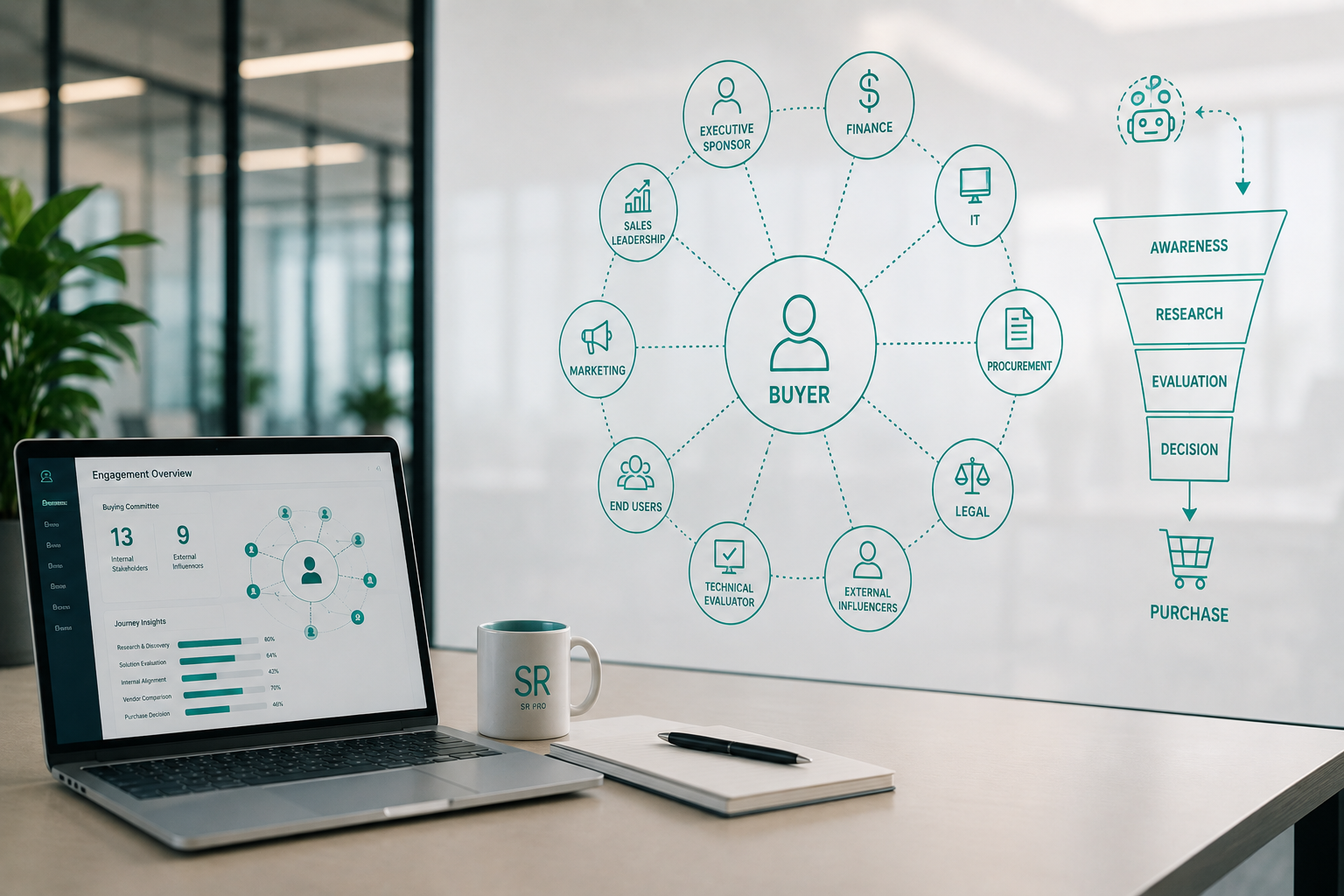
Forrester's 2026 research reports that the typical B2B buying decision includes 13 internal stakeholders and nine external influencers, with larger groups involved in more complex purchases.
That changes the way revenue teams need to think about engagement.
A single lead may represent only one person inside a much larger decision-making process.
Consider a company evaluating a new CRM platform.
One person may discover the solution.
Another may evaluate technical requirements.
Finance may review the cost.
IT may assess security.
Sales leadership may evaluate functionality.
Marketing may consider integrations.
Procurement may negotiate the contract.
The person who downloads a whitepaper is not necessarily the person who makes the final decision.
And the person who makes the final decision may never have downloaded anything.
Today, the buying process can also begin before the buyer reaches a vendor's website. A potential customer may ask an AI system about a problem, evaluate different solutions, or use AI to narrow down a list of vendors before entering a traditional marketing funnel.
The lead is an individual. The purchase is organizational.
That distinction is becoming increasingly important.
Customers Do Not Move Through a Funnel. They Move Through a Journey.
The traditional funnel assumes that buyers progress through a predictable sequence of stages.
Modern B2B buying rarely follows that pattern.
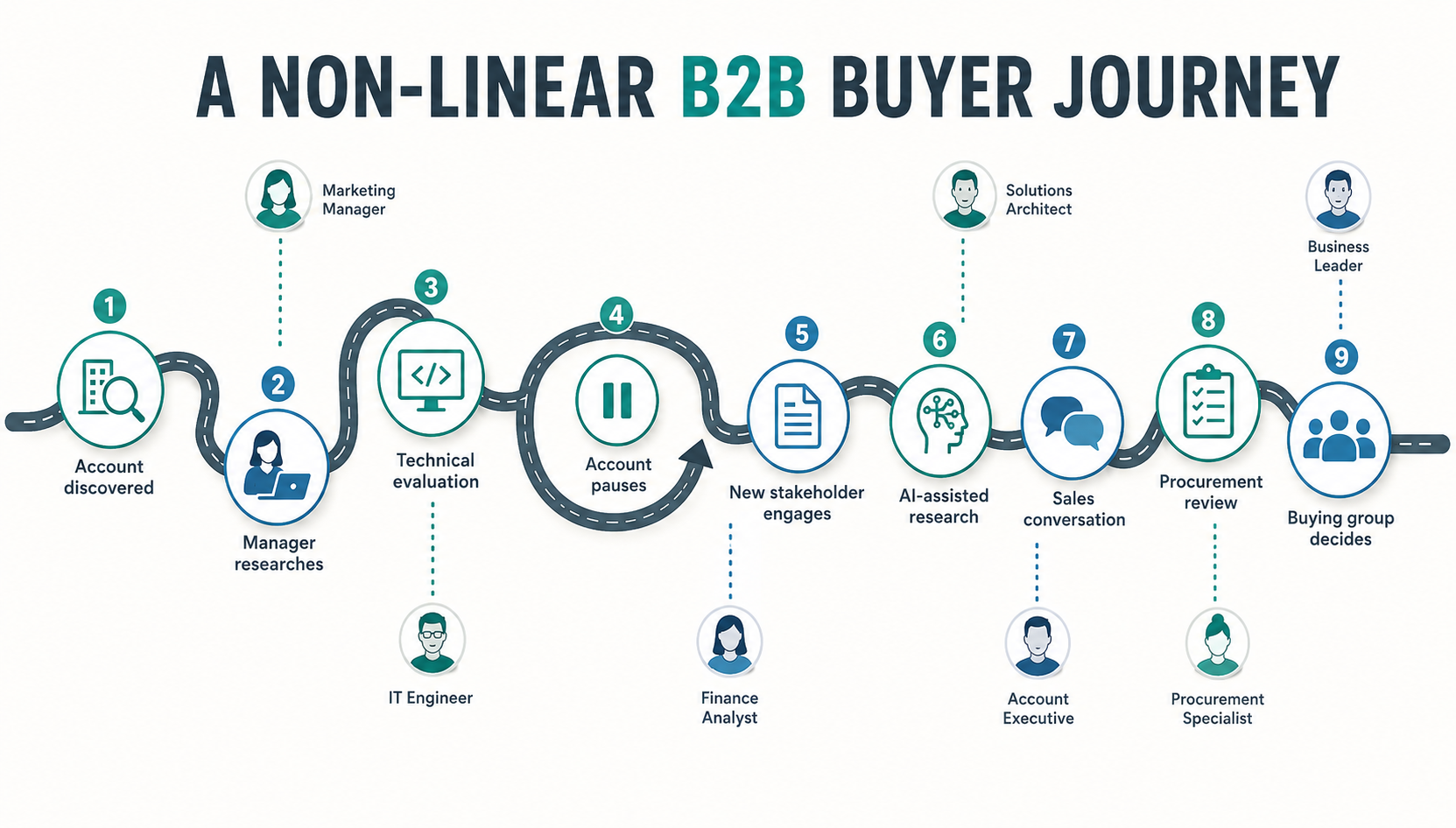
A buyer may move forward, revisit an earlier step, pause their research, or re-engage through a different channel.
New stakeholders can enter at any point, each bringing different priorities, questions, and levels of awareness.
A manager may begin researching a solution before involving a technical stakeholder. The account may then go quiet, only for another team member to re-engage with content or use AI to compare available options.
Sales, procurement, and other decision-makers may join later, changing the requirements or prompting the group to reconsider earlier conclusions.
The graphic illustrates how these interactions form a connected but non-linear journey.
There is rarely one moment when an entire buying group moves neatly from one stage to the next.
Instead, several individual journeys unfold at the same time and eventually come together around a purchasing decision.
The Rise of Buying Groups Changes the Funnel
One of the biggest changes in B2B revenue strategy is the increasing importance of buying groups.
A buying group is the collection of stakeholders involved in evaluating and making a purchasing decision.
This is fundamentally different from treating a single lead as the center of the opportunity.
We recommend that revenue teams identify and engage buying groups rather than treating individual leads as isolated opportunities.
This creates a different question for Marketing and Sales.
Instead of:
"Is this lead qualified?"
Teams increasingly need to ask:
"Do we understand the buying group behind this opportunity?"
Who is involved?
Who is influencing the decision?
Who is missing?
Who has engaged?
Who has not?
Who is responsible for evaluating the solution?
Who controls the budget?
Who could block the purchase?
These questions provide much more context than a single lead score.
The Funnel Can Hide Important Signals
Traditional funnel reporting often compresses complex buyer behavior into a single stage.
For example:
MQL
That label may represent a lead that downloaded a report.
But it could also represent someone who:
→ Visited the website repeatedly
→ Attended a webinar
→ Viewed product pages
→ Engaged with multiple emails
→ Came from a target account
→ Had several colleagues interact with the company
Those scenarios are not equivalent. The same MQL status can therefore represent very different levels of buying activity.
This is one reason revenue teams are increasingly looking beyond individual lead status toward account-level and buying-group signals.
The question becomes less:
"How many MQLs do we have?"
And more:
"Where is meaningful buying activity occurring?"

Lifecycle Stages Still Matter
Moving beyond the funnel does not mean abandoning lifecycle stages.
CRM structure is still essential.
The problem occurs when lifecycle stages are treated as a perfect representation of buyer behavior.
A CRM needs structured stages so that teams can coordinate.
Marketing needs to understand where contacts and accounts are in the relationship.
Sales needs to understand opportunity progression.
Customer Success needs visibility after the sale.
Leadership needs consistent reporting.
The solution is not removing structure.
It is designing a structure that reflects how the business actually operates.
Lifecycle stages should help answer questions such as:
→ What relationship does this contact have with the company?
→ What is happening at the account level?
→ Is there an active buying process?
→ What stage is the opportunity in?
→ What does the revenue team need to do next?
This requires thoughtful CRM architecture rather than simply adding more stages.
The Funnel and the Buyer Journey Are Not the Same Thing
This distinction is critical.
The buyer journey describes what the customer is doing.
The revenue process describes what the organization is doing.
They are connected. But they are not identical.
A company may define:
Lead → MQL → SQL → Opportunity → Customer
while the buyer experiences:
Research → Internal discussion → Vendor comparison → Technical validation → Budget approval → Procurement → Purchase
That research phase may now include traditional search, peer recommendations, vendor content, review sites, and AI-powered research.
These two systems need to work together.
If they do not, the CRM can become a representation of internal activity rather than customer reality.
The goal of RevOps is not to eliminate the revenue process.
It is to create better alignment between the company's operating model and the way customers actually make decisions.
Marketing and Sales Need More Than a Handoff
The traditional funnel often creates a handoff mentality.
Marketing generates leads.
Sales receives them.
Sales follows up.
Marketing continues generating more leads.
This model can create friction because the buyer does not experience Marketing and Sales as separate departments.
The buyer experiences one company.
If Marketing has information about what a prospect has researched, but Sales cannot see it, context is lost.
If Sales knows which stakeholders are involved but Marketing continues communicating with only one contact, an opportunity may be missed.
If Customer Success has important information about an existing account but Marketing and Sales cannot access it, expansion opportunities may be overlooked.
Revenue teams therefore need to think beyond handoffs.
The objective is continuous coordination.

The Customer Journey Does Not End at Closed-Won
Another limitation of the traditional funnel is that it often treats the customer as the endpoint.
But revenue does not necessarily end at the initial purchase.
After a customer buys, several things can happen.
They can:
→ Adopt the product
→ Expand usage
→ Purchase additional services
→ Renew
→ Refer other companies
→ Become advocates
Or they can:
→ Reduce usage
→ Become dissatisfied
→ Request support
→ Churn
This means the customer journey continues after acquisition.
A modern revenue model therefore needs to connect:
Acquisition → Conversion → Adoption → Retention → Expansion
Customer Success becomes part of revenue strategy.
Marketing becomes involved in expansion and advocacy.
Sales may become involved in renewals and account growth.
RevOps provides the infrastructure that connects these activities.
Revenue Does Not Move Through a Funnel
This is perhaps the most important conceptual change.
Revenue is the result of multiple interactions across the customer journey.
Marketing creates awareness and demand.
Sales helps buyers evaluate and make decisions.
Customer Success drives adoption and retention.
Product experiences influence expansion.
Partners and external communities influence perception.
AI-powered research can influence which vendors buyers consider before a direct sales interaction ever occurs.
Procurement affects the final decision.
Leadership determines strategic priorities.
All of these factors can influence revenue.
Trying to compress the entire process into one funnel can make reporting easier.
It does not necessarily make the business easier to understand.
The better objective is to create a connected revenue model.
What This Means for CRM Strategy
As buyer journeys become more complex, CRM strategy must evolve to capture the full context of each relationship, rather than tracking isolated contacts or individual sales opportunities.
A modern CRM should show who is involved, which organizations are engaging, and how different stakeholders contribute to the buying decision.
It should also connect those relationships with potential revenue, recorded interactions, lifecycle progression, and the customer’s experience after the purchase.
This connected view helps teams understand what is happening across an account, recognize meaningful engagement patterns, and determine the appropriate next action.
It also creates a stronger foundation for using CRM analytics to develop actionable growth strategies.
CRM architecture is therefore more than a database design exercise. It is a central part of the company’s revenue strategy, connecting buyer activity with the people, processes, and decisions that support growth.
Data Needs to Reflect the Buying Process
A complex buyer journey requires more than contact information.
Revenue teams need to understand relationships between people, accounts, activities, opportunities, and customers.
For example, imagine that three people from the same company interact with your organization within two weeks.
One downloads a report.
Another attends a webinar.
A third requests a product demonstration.
Looking at these contacts individually may produce three separate activities.
Looking at them together may reveal something much more important:
An account may be actively evaluating your solution.
This is why connected data becomes so important.
The signal is not necessarily the individual action. The signal can be the pattern across multiple stakeholders.
Measurement Needs to Change Too
If the buyer journey changes, the metrics used to evaluate it should change as well.
Traditional funnel reporting often focuses on:
→ Lead volume
→ MQL volume
→ SQL volume
→ Conversion rates
→ Pipeline
→ Revenue
These metrics remain useful.
But they can be complemented by measurements such as:
→ Account engagement
→ Buying group coverage
→ Stakeholder engagement
→ Opportunity progression
→ Time between buying stages
→ Pipeline velocity
→ Multi-threaded engagement
→ Expansion revenue
→ Retention
For example, instead of asking only:
"How many leads did Marketing generate?"
Revenue leadership might ask:
"How many target accounts showed meaningful buying activity?"
Instead of:
"How many MQLs did Sales accept?"
The question might become:
"How many active opportunities have the right stakeholders engaged?"
These questions connect marketing activity more directly to revenue outcomes.

RevOps Becomes More Important in a Non-Linear Revenue Model
As customer journeys become less predictable, businesses need an operational structure that can connect activity across channels, teams, and lifecycle stages.
Revenue Operations provides that structure by bringing together people, processes, data, and technology. It aligns these elements so marketing, sales, and customer success teams can work from consistent information and coordinate their activities throughout the customer journey.
This includes CRM architecture, lifecycle management, data governance, lead and account management, marketing automation, sales processes, customer success workflows, reporting, attribution, and revenue analytics.
When these areas work together, teams can move more effectively from data to decisions and build a faster revenue operation.
The goal is not to introduce more systems or operational layers.
It is to create a connected revenue model that reflects how customers actually research, evaluate, purchase, and expand their relationship with the business.
What Should Revenue Teams Do Next?
Moving beyond the funnel does not require rebuilding the entire revenue organization overnight.
A practical starting point is to examine the existing model.
1. Map the actual buyer journey
Look at what customers do before, during, and after sales engagement.
Include the channels buyers use to research, compare, and evaluate solutions, including AI-powered research where relevant.
2. Identify the buying group
Understand which roles typically influence the purchase.
3. Review CRM structure
Determine whether your CRM captures the relationships between contacts, accounts, opportunities, and customers effectively.
4. Examine lifecycle stages
Ask whether each stage represents a meaningful change in the relationship or simply an internal process milestone.
5. Expand measurement
Add account, opportunity, buying-group, and customer metrics where appropriate.
6. Align Marketing, Sales, and Customer Success
Make sure each team has access to the context required to understand the customer journey.
7. Use automation carefully
Automation should support the revenue process, not force customers into an artificial sequence.
The objective is not to eliminate structure.
It is to create structure around how customers actually buy.
The Future of Revenue Strategy Is Customer-Centered
The funnel gave businesses a useful framework for understanding growth.
But markets evolve.
Buyers have more information.
More stakeholders participate in decisions.
Digital channels have multiplied. Customers can research vendors independently.
They can increasingly use AI to understand problems, compare options, and narrow their choices before engaging directly with a vendor.
And the relationship between Marketing, Sales, Customer Success, and Revenue Operations has become increasingly interconnected.
The answer is not to throw away the funnel.
It is to stop treating it as the complete representation of revenue.
Revenue teams need a broader view.
One that connects:
Buyer Journey + Buying Groups + Revenue Process + Customer Lifecycle
That creates a much more realistic picture of how growth actually happens.
Conclusion
The traditional B2B funnel is not disappearing, but it can no longer fully explain how modern buying decisions happen.
Buyers research independently, consult AI tools, revisit earlier decisions, and interact with businesses through different channels.
Multiple stakeholders may enter the process at different times, while meaningful account engagement can occur long before someone becomes a formal lead.
The journey also continues after the initial purchase through onboarding, adoption, retention, and expansion.
Revenue teams therefore need technology, data, processes, and reporting that can capture these connected interactions.
The goal is not to force buyers through a fixed sequence of stages.
It is to understand the journey already taking place and give teams the context they need to respond effectively.
Revenue does not move through a funnel. Customers move through a journey.
Organizations that build their revenue operations around this reality are better positioned to align marketing, sales, customer success, and technology with how customers actually make decisions.
Explore SR Professional Marketing’s products to discover practical solutions designed to support connected operations, stronger customer insights, and more informed revenue decisions.