


Most organizations rely on their CRM as the backbone of marketing, sales, and customer operations. It is where leads are nurtured, deals are tracked, revenue is forecasted, and performance is measured. But when data quality deteriorates, that foundation erodes and the CRM shifts from a growth engine into a liability.
Duplicate records, outdated contacts, broken lifecycle stages, and unreliable reports often become “normal,” creating a hidden drain on revenue and efficiency. Remarkably, poor data rarely causes an instant failure. It quietly erodes value through wasted spend, missed opportunities, slower teams, and flawed decisions.
Cleanup is often postponed because it feels operational, not strategic. By the time the impact is obvious, the effort has grown larger, riskier, and more disruptive than necessary.
As 2026 approaches, the stakes are higher. With AI-driven systems making autonomous decisions, CRM data no longer just supports workflows but drives them. Think about it, bad data doesn’t just cause problems, it sabotages your system.
Read on to understand the true cost of CRM neglect and how marketing, sales, operations, and leadership teams can address it strategically.
What “CRM Cleanup” Really Means
When teams talk about CRM cleanup, they often think only of removing duplicates. While deduplication is important, it is just one piece of a much larger process. True CRM cleanup addresses both data quality and the underlying logic that governs how data is captured, used, and maintained.
- Inconsistent field values – Over time, fields accumulate variations that break segmentation, reporting, and automation. Free-text entries replace structured values, dropdowns grow unchecked, and teams use different terms for the same thing. These inconsistencies make workflows brittle and reporting unreliable.
- Broken lifecycle stages – Contacts skip stages, get stuck, or move backward. When lifecycle logic no longer matches how customers actually progress, attribution, scoring, and forecasting suffer.
- Stale or orphaned records – Old leads, former customers, and unassociated records clutter the system, complicating automation, reporting, and compliance.
- Misaligned contact and company data – Contacts linked to the wrong company, missing associations, or conflicting data create confusion for sales and inaccurate reporting for leadership.
If you think CRM cleanup is a one-time task, consider this: with new data constantly coming from forms, integrations, imports, APIs, and manual updates, even a freshly cleaned system will degrade without clear rules, governance, and ownership.
Common Signs Your CRM Is Already Costing You
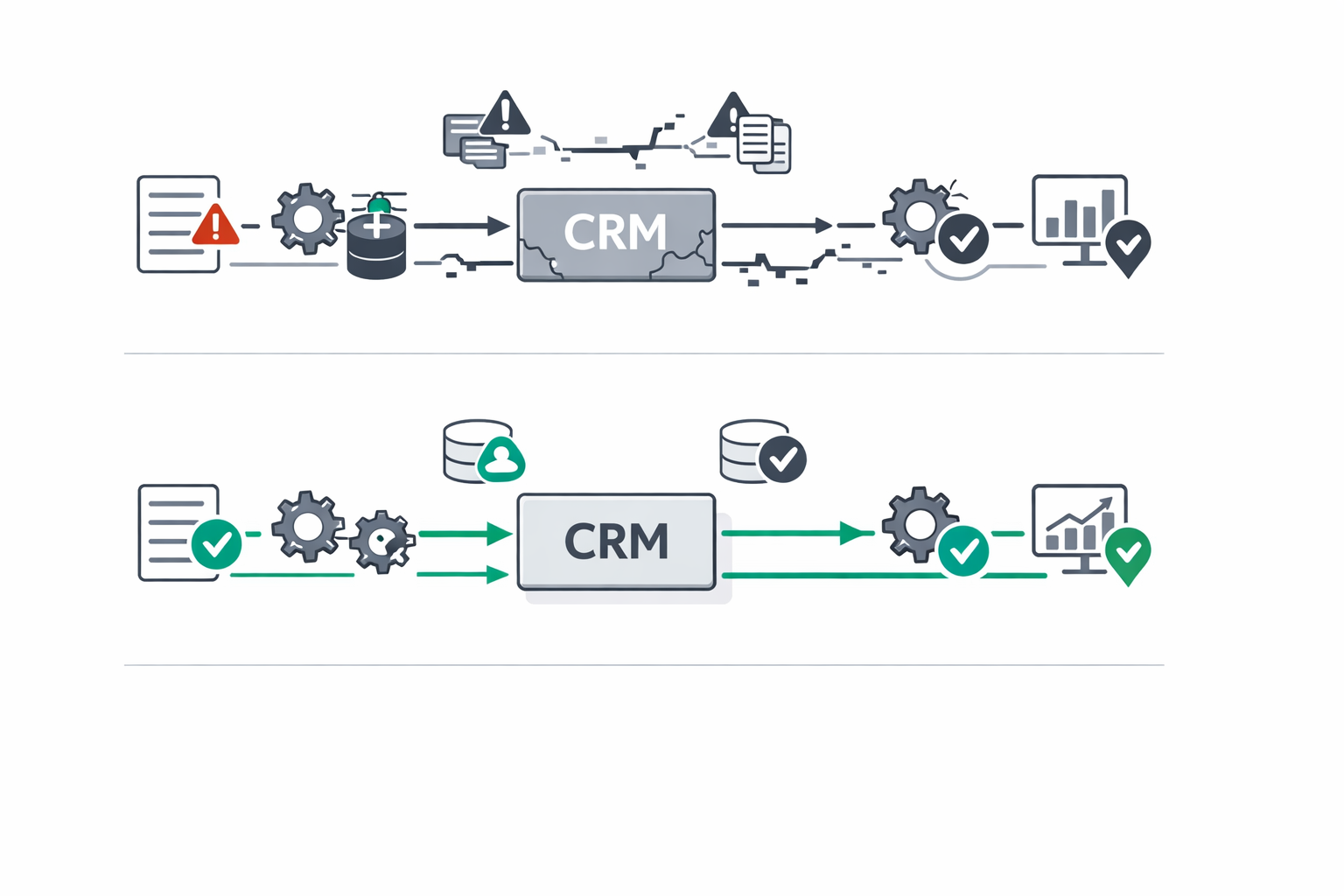
Even before a full-blown crisis emerges, poor CRM hygiene quietly impacts performance across marketing, sales, and operations. Data issues may seem like minor annoyances, but over time they ripple through processes, slowing teams, misaligning strategies, and eroding revenue. Here are key warning signs that your CRM is already holding your business back:
- Sales teams question lead quality or distrust pipeline data – When reps hesitate to act on leads or deals because they don’t trust the information, follow-ups are delayed, opportunities are missed, and forecasting becomes unreliable.
- Marketing reports require manual adjustments or disclaimers – Campaign performance and segmentation metrics need constant verification. Teams spend hours correcting reports instead of optimizing campaigns, reducing marketing efficiency.
- Automation triggers incorrectly or fails silently – Workflows, lead scoring, and routing rely on accurate data. When automation misfires or doesn’t trigger, leads fall through the cracks, and process efficiency drops.
- High-intent leads are missed or routed incorrectly – Poor data alignment or incomplete records can result in top opportunities being ignored or sent to the wrong team, directly affecting revenue.
- Teams build spreadsheets or shadow systems outside the CRM – When trust in the CRM erodes, employees create workarounds. These side systems fragment data, increase errors, and make cross-team collaboration nearly impossible.
More than operational hiccups, these patterns signal that the CRM is no longer a reliable source of truth. Once trust is lost, adoption drops, errors compound, and data quality declines even faster.
The Real Cost of Ignoring CRM Hygiene
Poor CRM hygiene quietly drains revenue, slows teams, and undermines strategic decisions. Even small data issues can ripple across marketing, sales, and leadership, creating inefficiencies that compound over time. Here’s how neglecting CRM hygiene impacts your business:
- Wasted marketing spend – Inaccurate or inconsistent data leads to poorly targeted campaigns. Emails reach the wrong contacts, suppression lists fail, and personalization falls flat. Marketing budgets are spent without confidence in the results, reducing ROI and limiting campaign effectiveness.
- Lost sales opportunities – Leads are misrouted, scoring models fail, and incomplete contact histories leave reps chasing dead ends. High-potential deals slip through the cracks, and lost revenue often goes unnoticed because it never enters the pipeline.
- Operational inefficiency – Teams spend valuable hours validating data, correcting errors, and building workarounds. Manual fixes replace automation, slowing productivity and increasing frustration across departments.
- Flawed leadership decisions – Reports, forecasts, and performance analyses rely on accurate CRM data. When the underlying data is flawed, leadership decisions are made on assumptions instead of facts, risking misaligned strategies and missed opportunities.
Over time, this technical debt in CRM data becomes business debt. It limits growth, reduces scalability, and undermines your organization’s competitive edge.
Why CRM Cleanup Keeps Getting Delayed
Despite the clear risks, CRM cleanup is often postponed. The work feels daunting, and its value is not always immediately visible. Several common factors contribute to this delay:
- It rarely feels urgent until something breaks – Because CRM issues accumulate gradually, their impact is often invisible until errors disrupt processes, misroute leads, or cause reporting failures. By then, the problem has grown much larger and more complicated to fix.
- Ownership is unclear across marketing, sales, and operations – Without a designated team or accountable leader, cleanup responsibilities fall through the cracks. Conflicting priorities between departments leave the CRM in a perpetual state of neglect.
- Teams fear disrupting existing automation or pipelines – Cleaning up data or restructuring workflows can feel risky. Teams worry that touching the system might break active campaigns, automated processes, or integrations, so they avoid taking action.
- Historical context and documentation are missing – Many CRMs have evolved over years with multiple admins, processes, and integrations. Without clear records of past changes, teams struggle to understand the root of data issues or predict the impact of cleanup efforts.
- The effort is underestimated and poorly scoped – Cleanup is often seen as a quick fix. In reality, it requires detailed analysis, coordination, and planning. Underestimating its scope leads to frustration, abandoned efforts, and recurring problems.
Cleanup feels risky and complex, especially in mature systems. As a result, teams prioritize short-term stability over long-term CRM health, allowing issues to compound over time.
The 2026 Reality: Why Cleanup Matters More Than Ever
As we approach 2026, several trends make CRM cleanup more urgent than ever. The stakes are higher, and the cost of poor data quality is amplified across marketing, sales, and operations. Companies are increasingly relying on automation and AI to make decisions. When CRM data is inaccurate or incomplete, these systems can make incorrect actions at scale, affecting lead routing, campaigns, and revenue outcomes.
Data privacy and governance requirements are also stricter. Organizations must ensure data is accurate, traceable, and properly controlled. Poor data hygiene increases the risk of compliance violations and reputational damage.
Customer journeys have become more complex, spanning multiple channels and touchpoints across marketing, sales, and service.
Small data errors can quickly cascade, disrupting workflows and impacting customer experience.
Finally, many companies have large amounts of data but cannot trust or use it effectively. Competitive advantage will go to organizations that maintain clean, reliable, and actionable CRM data. In this context, cleanup is no longer optional but is essential for scaling operations and making confident business decisions.
What a Proper CRM Cleanup Process Looks Like
A successful CRM cleanup is not a quick fix. It requires a structured, step-by-step approach that addresses both data quality and the processes that rely on it. Skipping steps or rushing the process often leads to recurring problems. Here’s a practical roadmap for an effective cleanup:
Step 1: Audit Before Action
Start by assessing the current state of your CRM. Identify duplicate records, invalid or incomplete fields, outdated contacts, and inaccurate company information. Quantify the scope of the issues so you understand the effort required. At the same time, map how data flows into, through, and out of your CRM. This includes forms, integrations, imports, and manual entries. Process mapping helps you distinguish between symptoms and root causes, ensuring you address the underlying issues rather than just the surface problems.
Step 2: Define a Single Source of Truth
Determine which fields and objects are authoritative for critical data points. Decide which system or team owns each type of data, and resolve conflicts between overlapping sources. This reduces confusion, ensures consistency across departments, and forms the foundation for reliable automation and reporting.
Step 3: Standardize Fields, Values, and Lifecycle Logic
Align field definitions, dropdown options, and naming conventions across marketing, sales, and operations. Standardize lifecycle stages to reflect actual customer journeys. Clear, consistent definitions prevent misinterpretation, reduce errors, and make automation predictable and reliable.
Step 4: Deduplicate with Rules, Not Guesses
Merge duplicate records using defined criteria and controlled processes. Avoid manual, ad hoc decisions that can introduce new inconsistencies. Use automated tools when possible, but verify results with spot checks to ensure critical data is preserved and relationships between contacts and companies remain accurate.
Step 5: Validate Automation and Reporting
After cleanup, test all workflows, scoring models, lead routing rules, and dashboards. Use real-world scenarios to ensure automation triggers correctly and reports reflect accurate, actionable data. This step confirms that the cleanup supports operational efficiency rather than creating new problems.
Step 6: Document Everything
Document all changes, standards, and processes. Include definitions, rules, and responsibilities for data management. Comprehensive documentation ensures continuity, supports onboarding of new team members, and prevents regression as teams evolve or systems are updated.
A structured approach like this transforms CRM cleanup from a reactive task into a strategic foundation, improving efficiency, data reliability, and business decision-making.
Who Should Own CRM Data Quality and How to Prevent Another Cleanup Crisis
CRM data quality cannot be the responsibility of a single team. Marketing should manage acquisition quality and segmentation, sales should maintain pipeline accuracy and update contacts, operations should enforce structure and governance, and leadership should set priorities and ensure accountability. Shared ownership does not mean bureaucracy; it requires clear roles, visibility, and alignment.
To prevent future cleanup crises, embed data hygiene into daily workflows, monitor quality continuously, train teams on consistent practices, and establish clear rules for imports, integrations, and automation changes. When data discipline becomes part of everyday operations, CRM cleanup stops being a disruptive, reactive task.
When to DIY and When to Bring in Experts
Internal teams can handle basic cleanup tasks when the CRM is simple and well-documented. However, expert support becomes necessary when lifecycle models conflict across teams, automation has grown without proper governance, integrations and imports span multiple years, or institutional knowledge has been lost. In these situations, a structured cleanup approach reduces risk and long-term costs compared to letting inefficiencies persist.
Conclusion: Your 2026 Competitive Advantage
CRM cleanup is often seen as routine maintenance, but it is actually a strategic investment. Organizations that maintain clean, reliable CRM data move faster, scale automation safely, and make confident, data-driven decisions.
Delaying cleanup carries hidden costs and compounds risk. The longer it is postponed, the more difficult and expensive it becomes.
The cleanup no one wants to do often becomes the quiet advantage for teams that outperform in the next era of marketing and revenue operations. As automation and data-driven decisions become critical in 2026, a clean CRM foundations matter more than ever. Contact us today to ensure your CRM is built to scale with confidence.