

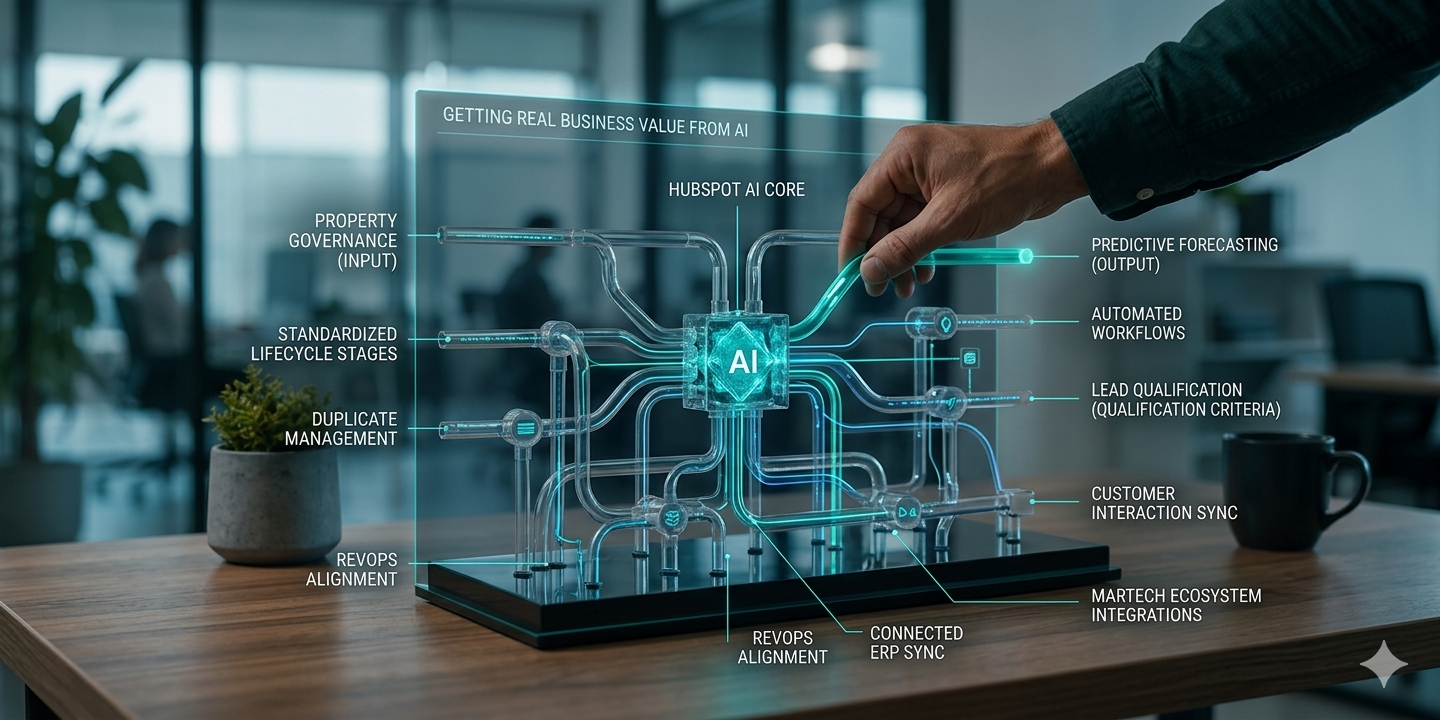
Artificial intelligence is becoming a larger part of the HubSpot experience.
From content generation and workflow recommendations to AI agents and predictive capabilities, HubSpot continues to introduce new ways to help teams work more efficiently. For many organizations, these features promise faster execution, better customer experiences, and improved productivity.
But there is an important reality that many companies are discovering.
AI does not automatically solve operational problems.
Simply turning on AI features does not guarantee better outcomes. In fact, organizations with inconsistent processes, poor data quality, and unclear ownership often struggle to see meaningful results.
The technology itself is rarely the problem.
The foundation behind it is.
As AI capabilities continue to evolve, businesses are learning that the value of AI inside HubSpot depends heavily on the quality of the systems supporting it.
AI Does Not Replace Operational Foundations
There is growing excitement around AI across the HubSpot ecosystem.
Many teams expect AI to improve lead qualification, content creation, reporting, customer interactions, workflow automation, and forecasting.
These capabilities can absolutely create value.
However, AI still depends on the information and processes available to it. AI does not replace strong operational foundations.
If lifecycle stages are inconsistent, properties are duplicated, or ownership rules are unclear, AI will inherit those same problems.
A disorganized CRM often leads to:
- Inaccurate recommendations
- Poor segmentation
- Inconsistent reporting
- Broken workflows
- Low confidence in the data
AI can accelerate execution, but it cannot compensate for operational chaos.
This is one reason many organizations are shifting their focus from AI features to CRM readiness.
Clean Data Is More Important Than Ever
The quality of AI output depends heavily on the quality of the data behind it. This principle has always mattered, but AI makes it even more visible.
According to Gartner, 2025, organizations will abandon 60% of AI projects unsupported by AI-ready data through 2026. This highlights the growing importance of data readiness as AI adoption accelerates.
When records are incomplete, duplicated, or outdated, AI systems struggle to generate reliable results.
As a result, marketing teams may experience incorrect personalization, poor lead prioritization, inconsistent attribution, reporting discrepancies, and workflow errors.
Sales teams may lose confidence in recommendations.
Customer success teams may struggle with visibility.
Instead of improving productivity, AI can amplify existing problems.
Strong data practices become increasingly important as organizations adopt more AI-driven processes.
This includes:
- Property governance
- Duplicate management
- Standardized naming conventions
- Data enrichment
- Consistent lifecycle definitions
The goal is not simply to maintain a cleaner CRM. It is to create a foundation that allows AI to perform effectively.
Process Clarity Matters Just as Much

AI performs best when processes are already well defined.
For example, an AI-powered lead qualification system still needs:
- Clear lead stages
- Ownership rules
- Routing logic
- Qualification criteria
- Consistent definitions
Without those elements, AI has no reliable framework to support decision-making.
This applies across many areas inside HubSpot. Campaign management, customer onboarding, reporting, and service operations all benefit from clear processes.
Organizations sometimes expect AI to create structure automatically. In reality, structure needs to exist first.
AI works best when it enhances existing systems rather than replacing them.
Ownership Creates Better Outcomes
Another common challenge involves ownership.
As AI capabilities expand, organizations need to define who is responsible for maintaining processes, reviewing outputs, and ensuring quality.
Questions such as these become increasingly important:
- Who owns lifecycle management?
- Who defines qualification criteria?
- Who maintains workflows?
- Who is responsible for reporting accuracy?
- Who reviews AI-generated recommendations?
Without clear ownership, operational issues tend to multiply.
AI can improve efficiency, but it still requires accountability.
This is one reason RevOps teams are becoming more involved in AI initiatives. Their role naturally connects systems, processes, and teams.
AI Works Best Inside Connected Systems
HubSpot rarely operates in isolation.
Most organizations rely on a broader martech ecosystem that often includes platforms such as Salesforce, Marketo, Google Workspace, ERP systems, customer support platforms, data warehouses, and communication tools.
These systems work together to support marketing, sales, operations, customer service, and business intelligence across the organization. AI becomes significantly more useful when these systems are properly connected.
Disconnected tools create fragmented information and inconsistent customer experiences.
Connected systems improve context, visibility, reporting, automation, and collaboration across teams. The goal is not to add more technology, but to create a connected ecosystem where data flows seamlessly and teams can work more efficiently with the information they need.
This is where much of AI’s business value comes from.
Context Is Becoming a Competitive Advantage
One of the biggest shifts happening in AI is the growing importance of context.
Data alone is no longer enough. AI systems perform better when they understand:
- Customer history
- Previous interactions
- Lifecycle stages
- Product usage
- Sales activity
- Support conversations
Context allows AI to generate more relevant recommendations and automate processes more effectively.
This is one reason many organizations are investing in stronger CRM architecture and better data management.
The more context available, the more useful AI becomes.
In many ways, context is becoming one of the most valuable assets inside Revenue Operations.
Why RevOps Plays an Important Role
AI adoption is no longer just a technology discussion. It is becoming an operational discussion.
Successful AI initiatives require alignment between:
-
* Marketing
-
* Sales
-
* Customer success
-
* Operations
-
* Technology
RevOps is uniquely positioned to support that alignment.
Standardized processes and improved visibility across teams create the foundation AI needs to generate meaningful and reliable results.
Rather than treating AI as a standalone project, many organizations are beginning to approach it as part of a broader revenue strategy.
This shift helps reduce silos and improve long-term scalability.
AI Should Improve Work, Not Add Complexity
There is sometimes a tendency to adopt AI simply because new features are available.
But adding technology without addressing underlying processes often increases complexity rather than reducing it.
The most successful organizations focus on a different question. Instead of asking:
“Which AI features should we turn on?”
They ask:
“What business problems are we trying to solve?”
This approach leads to more practical use cases and stronger adoption.
Examples include:
- Automating repetitive tasks
- Improving lead qualification
- Enhancing customer experiences
- Reducing manual work
- Strengthening reporting accuracy
- Accelerating internal processes
AI delivers the greatest value when it supports business objectives rather than becoming an objective itself.
HubSpot AI Is Becoming More Powerful. Preparation Matters More Than Ever.

HubSpot continues to expand its AI capabilities, and that trend will likely accelerate over the coming years.
However, organizations that see the greatest value from these innovations will not necessarily be those with the most AI features enabled.
Success will come to businesses that have built a strong operational foundation with a well-structured CRM, clean and reliable data, clearly defined ownership, connected systems, and efficient processes.
AI can amplify efficiency. But it also amplifies the quality of the systems behind it.
The better the foundation, the better the results.
Final Thoughts
AI inside HubSpot has enormous potential. But technology alone is not enough.
Clean data, process clarity, ownership, and system connectivity all play a critical role in determining whether AI creates real business value.
Organizations that invest in these foundations are putting themselves in a stronger position to take advantage of the next generation of AI capabilities.
At SR Pro, we believe AI should support the way teams already work, not introduce unnecessary complexity. Through RevOps, HubSpot optimization, and custom solutions, organizations can build the operational foundations that allow AI to deliver meaningful and scalable results.
The future of AI inside HubSpot will not be defined by features alone. It will be defined by the quality of the systems that make those features useful.