


Customer expectations are higher than ever. Marketing teams need better targeting. Sales teams need clearer pipelines. Service teams must respond faster.
To support this level of coordination, companies need more than a basic CRM. They need a platform that integrates marketing, sales, service, and operations into a single system.
This is one reason HubSpot remains one of the most widely adopted CRM platforms in 2026. The platform combines customer data, automation, and artificial intelligence into a single ecosystem designed to help businesses grow in a structured way.
But what makes HubSpot stand out today is not only its CRM. It is the RevOps-focused architecture behind the platform. When configured correctly, HubSpot allows teams to manage the full customer lifecycle from one place.
In this article, we explore how HubSpot works, what tools it offers, and why many organizations choose it as the foundation for their revenue operations strategy.
Understanding the HubSpot Platform
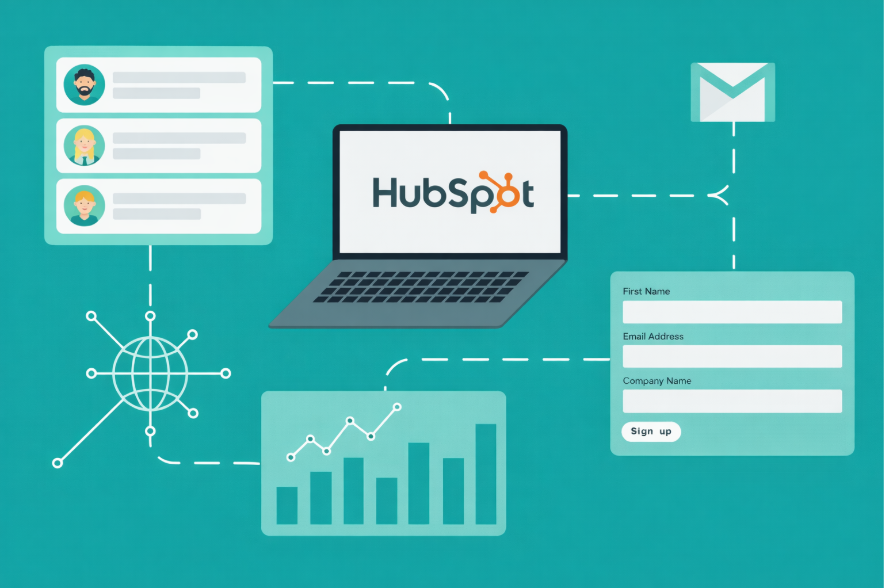
HubSpot is often described as a CRM, but the platform is broader than that. It is designed as a customer platform that connects several business functions around one shared database.
At the center of the platform is the Smart CRM, which stores contact data, company records, deals, and customer interactions. Around this core database are several specialized products called Hubs, each built for a specific business function.
This structure allows companies to start with a simple CRM and gradually expand into marketing automation, sales enablement, and customer service tools without moving to a different system.
Many organizations adopt HubSpot because it combines multiple tools that would otherwise require several separate platforms. The goal is to keep customer data centralized, so every team works with the same information.
The HubSpot Ecosystem: Core Hubs Explained
HubSpot organizes its capabilities into different hubs that support the full customer journey.
Marketing Hub
.png?width=893&height=403&name=imagen%20(3).png)
Marketing Hub focuses on lead generation and campaign management.
It includes tools that help marketing teams attract visitors, convert leads, and measure campaign performance. Common features include:
- Email marketing automation
- Landing page creation
- Lead capture forms
- Campaign analytics
- Marketing workflows
These tools help marketing teams manage inbound marketing strategies and track engagement across channels.
Because all interactions are stored in the CRM, marketing activity can be connected directly to sales results.
Sales Hub

Sales Hub is designed to help sales teams manage their pipelines and close deals more efficiently.
It includes tools for:
- Deal pipeline management
- Meeting scheduling
- Email tracking
- Sales automation
- Forecasting and reporting
The pipeline visualization allows sales managers to track deal progress and identify bottlenecks in the sales process.
Sales Hub also integrates closely with email providers and calendars, allowing sales teams to work directly from their inbox while keeping CRM data updated automatically.
Service Hub
.png?width=980&height=420&name=imagen%20(5).png)
Service Hub focuses on customer support and post-sale engagement.
It provides tools for managing customer conversations and support requests, including:
- Ticket management systems
- Shared team inboxes
- Live chat and messaging
- Customer feedback surveys
- Knowledge base creation
These features help organizations build structured support processes while keeping customer interactions connected to the CRM.
When service data is linked with marketing and sales data, companies gain a more complete understanding of the customer lifecycle.
Content Hub
.png?width=980&height=372&name=imagen%20(6).png)
Content Hub allows companies to manage digital content and websites inside the HubSpot ecosystem.
It includes:
- Website hosting and CMS tools
- Blog publishing
- SEO recommendations
- Landing page management
- Content analytics
This allows marketing teams to create content while directly tracking how visitors interact with the brand.
Because the CMS is connected to the CRM, companies can personalize content based on visitor behavior and contact data.
Operations Hub
.png?width=975&height=396&name=imagen%20(7).png)
Operations Hub supports data management and system integration.
As companies grow, they often rely on multiple tools for different functions. Operations Hub helps connect those tools while keeping data consistent.
Key capabilities include:
- Data synchronization between systems
- Workflow automation
- Data quality management
- Custom integrations
For RevOps teams, this hub plays an important role in maintaining reliable customer data across marketing, sales, and service platforms.
Commerce Hub
.png?width=983&height=426&name=imagen%20(8).png)
Commerce Hub focuses on revenue transactions and payments.
It allows companies to manage quotes, invoices, and payments directly within HubSpot.
Features include:
- Quote creation
- Payment processing
- Subscription management
- Billing automation
This helps businesses connect revenue data with customer records, making financial activity visible within the CRM.
Artificial Intelligence Inside HubSpot
Artificial intelligence has become a major focus for HubSpot in recent years. The company introduced an AI platform called Breeze, which integrates AI capabilities across marketing, sales, and service tools.
Breeze is designed to help teams automate tasks, generate insights, and make faster decisions.
Breeze Assistant
.png?width=1070&height=607&name=imagen%20(9).png)
Breeze Assistant acts as a conversational AI interface within HubSpot. It allows users to ask questions, summarize data, and generate content using CRM information.
Teams can use it to:
- draft marketing emails
- summarize deal records
- analyze customer activity
- generate marketing content
Because it has access to CRM data, the assistant can provide responses based on real customer information.
Breeze Agents
Breeze Agents extend AI capabilities further by automating specific tasks across teams.
These agents can handle activities such as:
- responding to customer inquiries
- generating marketing content
- supporting sales prospecting
- identifying knowledge base gaps
Some organizations already use AI agents to resolve a large portion of support conversations automatically, reducing response time and operational workload.
The goal is not to replace teams but to reduce repetitive work so employees can focus on strategy and relationship building.
Breeze Intelligence
Another layer of the AI system focuses on data enrichment and analysis.
Breeze Intelligence can analyze customer behavior, enrich company records, and identify buying signals to help teams prioritize leads.
These capabilities make the CRM more useful for forecasting and segmentation.
The Role of RevOps in HubSpot
One reason many companies choose HubSpot today is its alignment with Revenue Operations (RevOps) principles.
RevOps focuses on aligning marketing, sales, and customer success teams around shared processes and data.
Traditional organizations often use separate tools for each department. This leads to fragmented customer information and inconsistent reporting.
HubSpot addresses this challenge by storing all customer interactions in a single system.
When implemented correctly, the platform enables:
- shared lifecycle stages across teams
- unified reporting for marketing and sales
- better attribution of revenue to campaigns
- consistent data governance
This structure allows organizations to track the full customer journey, from first website visit to closed deal and ongoing support.
Pricing and Scalability
HubSpot offers several pricing tiers that allow businesses to adopt the platform gradually.
The CRM itself includes a free version that provides core features such as contact management, deal tracking, and email integration.
As companies grow, they can upgrade to paid plans that add advanced capabilities such as automation, advanced analytics, and AI tools.
Plans typically scale across different levels:
- Starter
- Professional
- Enterprise
Organizations can also combine multiple hubs into bundled plans that provide access to the full platform.
While HubSpot can become expensive at higher tiers, the pricing model allows businesses to start small and expand as their operations mature.
Advantages of Using HubSpot
Many organizations choose HubSpot for several reasons.
First, the platform is known for its ease of use. The interface is designed to be accessible even for teams without technical backgrounds.
Second, the ecosystem approach means companies can manage marketing, sales, service, and content in one place rather than integrating many separate tools.
Third, HubSpot offers strong educational resources through HubSpot Academy, helping teams learn how to use the platform effectively.
Finally, the growing AI ecosystem allows organizations to experiment with automation without building complex systems from scratch.
Potential Limitations
Despite its advantages, HubSpot is not the perfect solution for every company.
Advanced customization may require technical expertise or custom development. Some organizations with very complex sales processes may still prefer highly customizable platforms like Salesforce.
Pricing can also increase significantly as companies adopt advanced features or scale their teams.
For this reason, many businesses work with experienced partners to design the right architecture before implementing the platform.
Final Thoughts: Is HubSpot the Right CRM for 2026?
HubSpot continues to evolve beyond a traditional CRM. It has become a full customer platform that combines automation, data management, and AI capabilities.
For many companies, the biggest advantage is the ability to manage marketing, sales, and service from one system while maintaining a consistent view of the customer.
However, the true value of the platform depends on how it is implemented. Without clear data structure and RevOps alignment, even the most powerful CRM can produce limited results.
Organizations that treat HubSpot as a strategic system rather than just another marketing tool often see the greatest impact.
At SR Pro Marketing, we help companies design HubSpot architectures that support scalable revenue operations, reliable data, and AI-ready systems.
If your team is considering HubSpot or looking to improve an existing implementation, the first step is building the right foundation.